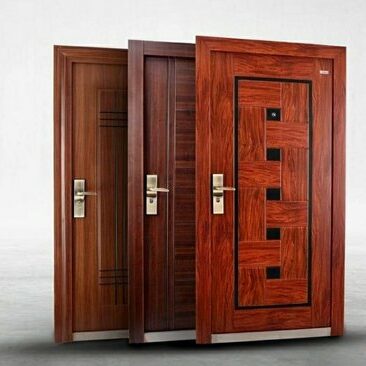

Doors After a Basement Flood or Humidity Spike: What Survives and What Does Not
door repairAfter water gets into a house, doors are rarely the first thing anyone thinks about. Flooring, drywall and contents come first, and that is the right order. But doors are quietly one of the more expensive things water touches, because a door that has taken on moisture often looks completely normal for several weeks and then stops working long after the cleanup crew has gone.
The question people ask is whether a door that got wet can be saved. The honest answer is that it depends almost entirely on how the door is built, where the water reached, and how fast the house dried out.
Doors do not all absorb water the same way
Hollow core interior doors
A hollow core door is two thin skins over a cardboard honeycomb in a softwood frame. The skins are the only part with any real resistance, and the bottom edge is usually unsealed because it was trimmed on site. Standing water goes straight up into the core by capillary action.
Once the honeycomb is wet it loses rigidity and does not recover. The skin delaminates from the frame, usually appearing as a bubble or a soft patch near the bottom corner. These doors are generally not worth drying out. They are the cheapest doors in the house and the most thoroughly ruined by water.
Solid core and engineered doors
A solid core door has a particleboard or engineered wood core. That core is far more structural than a honeycomb, and it is also far more absorbent. Particleboard that gets saturated swells irreversibly, because the swelling comes from the wood fibres expanding past the point where the resin bond holds them.
A solid core door that got its bottom two inches wet may be recoverable if it dried quickly. One that stood in water for a day usually will not be, and the giveaway is a bottom edge that is visibly thicker than the rest of the door. If it will not fit the opening any more, there is nothing to plane off that fixes it, because the swelling is through the thickness, not just the face.
Solid wood doors
Real wood is the most forgiving in a flood and the most troublesome afterwards. Wood swells and shrinks with moisture and it does most of that movement across the grain, not along it. A solid wood door that got wet will swell, bind in its frame, and then, as it dries, shrink back, often not to the same shape.
The common outcome is cupping or twist. The door closes at the top and stands proud at the bottom, or it touches the stop on one side and gaps on the other. Wood doors often need months before you know what shape they settled into, which is why rushing to plane one down right after a flood is a mistake. Plane it while it is swollen and you will have gaps when it dries.
Fibreglass and steel
Exterior fibreglass and steel doors handle water far better, since the skin does not absorb. What fails is the core and the bottom rail. Steel doors can rust from the inside where the skin is cut, and both types usually have a wood or composite bottom rail that behaves like any other wet wood. The skin looks perfect while the rail inside is going soft.
The frame matters as much as the door
This is the part that gets missed. People replace a warped door, hang the new one, and find it still does not close properly.
Jambs are usually softwood and they wick water upward from the floor. A jamb that has swollen pushes the stop inward and narrows the opening. A jamb whose bottom has gone soft no longer holds hinge or strike screws, so the door sags even though the door itself is new. And if the subfloor under the jamb lifted, the whole frame is now out of plumb.
Checking the frame before ordering a door saves a second visit. A straightedge against the jamb and a level on both legs tells you most of it. Door and frame repair is frequently the real job after water damage, with the door itself being the visible half of it.
Humidity alone can do this too
It does not take a flood. A basement that ran at high humidity through a summer, a bathroom with no working fan, a new build still giving off construction moisture, all produce the same symptoms more slowly. Doors that stick every summer and free up every winter are reacting to seasonal humidity, and that is normal movement rather than damage.
The distinction worth making is whether the door returns to normal. Seasonal sticking that reverses is a fitting issue and can be dealt with by adjusting hinges or easing a specific edge. Sticking that gets worse each year and never fully reverses means the door or the frame is taking on moisture it is not giving back, and the cause is usually below, not at the door.
How to tell what is salvageable
- Press the bottom corners. Any softness or give means the core is compromised. That door is finished.
- Look along the face from the hinge edge. Cupping and twist are easier to see down the length than straight on.
- Measure the door thickness at the bottom and the middle. A difference means swelling, which does not reverse in engineered cores.
- Check for delamination as bubbling, a hollow sound when tapped, or a lifted edge on the veneer.
- Wait before planing wood doors. Give a solid wood door a full drying season before reshaping it.
- Check the jambs and the floor before deciding the door is the problem.
Where several doors are affected, there is a practical argument for handling them together rather than one at a time, because the frames usually need attention at the same moment and sizes rarely match across an older house. Replacing doors as a set tends to go better than replacing them one at a time over a year.
Do not forget the hardware
Mortise locks, tubular latches and hinges all contain steel springs and small moving parts. Water plus the minerals in it leaves deposits inside a latch that make it sluggish months later. A latch that has got slow or a key that has started to feel gritty after a flood is usually telling you the mechanism is corroding internally. Those parts are cheap next to a door, and they are easy to overlook when the attention is all on the big visible damage. If doors across the house have started behaving differently since the water, a single visit to go through them usually sorts out more than expected.
Frequently asked questions
Can a swollen door be planed down to fit?
Sometimes, on solid wood, and only after it has fully dried. On engineered or hollow core doors planing removes material without fixing the distortion and usually exposes the core.
How long should I wait before deciding?
For wood doors, allow a full drying season. For hollow core doors, the decision is usually obvious within days, because the skin lifts.
Does a door that got wet need replacing even if it still closes?
Not necessarily. If it closes, latches, and shows no soft spots or delamination, it may be fine. Check again after a few months, as distortion can appear late.
Why does my new door still stick after replacing a damaged one?
Almost always the frame. A swollen or sagging jamb, or a subfloor that lifted, narrows and skews the opening regardless of which door is hanging in it.
Is a damaged interior door worth repairing?
Rarely for hollow core, since the door is simple and the labour outweighs it. Solid wood doors, especially older ones, are often worth repairing because the replacement is not equivalent.