Commercial Door Closers: Reading the Warning Signs Before the Door Slams or Sticks
commercial Door RepairThe door closer is the most-used and least-noticed piece of hardware in any commercial building. It cycles hundreds of times a day, it is bolted where nobody looks, and it gets attention only when the door slams hard enough to startle someone or stops closing altogether.
Both of those are late-stage symptoms. A closer gives you warning signs weeks before it fails, and on a fire-rated opening the failure is a compliance problem, not just an annoyance.
What the closer is actually doing
A door closer is a hydraulic device. A spring stores the energy you put in when you open the door; a piston forces oil through metered valves to control how that energy is released on the way back. The valves are what make the difference between a controlled close and a slam.
Most commercial closers have three or four adjustments:
- Sweep speed — controls the door from full open down to roughly 15 degrees from the frame.
- Latch speed — controls the last few degrees, where the door needs enough momentum to engage the latch but not enough to bang.
- Backcheck — a cushion near the fully open position that stops the door being thrown into the adjacent wall.
- Spring power (size) — how much force it takes to open the door, set by the closer’s size and often by an adjustable spring.
Almost every “the closer is broken” call is actually one of these four being out of adjustment, worn, or wrong for the opening in the first place.
Reading the symptoms
The door slams
Latch speed is set too fast, or the closer has lost fluid and can no longer meter it. Test which by pushing the door closed slowly by hand from about 20 degrees. If it feels loose and offers no resistance, the closer is losing internal control and adjustment will not hold.
The door hangs open and never latches
Spring power is too low for the door, or the latch speed is throttled too far, or the door and frame have shifted so the latch is now binding. On an exterior door, this is very often air pressure rather than hardware — stack effect in a multi-storey building can hold a door open against a correctly sized closer.
The door is too heavy to open
Spring power set too high. This is the most common over-correction: someone complains the door does not latch, a maintenance person cranks the spring, and now the entrance is a barrier for anyone with limited strength. On an accessible entrance there are limits on opening force, and a cranked closer will fail that check.
There is oil on the door or the frame
Seal failure. Once a closer leaks it cannot be adjusted back into service and it cannot be topped up — the unit is replaced. Oil marks running down the door face are the clearest end-of-life signal there is.
The door slams open into the wall
Backcheck has failed or was never set. Left alone this destroys the closer arm, the top hinge and eventually the frame, and it puts a doorknob-shaped hole in the drywall.
The closer body has shifted or the screws have pulled out
The mounting has failed, usually because the door skin or frame reinforcement was never adequate for the load. Re-screwing into the same holes buys days. Proper repair means a reinforcing plate or a sex-bolt through-fixing.
Why this matters on a rated opening
On a fire-rated door assembly the closer is not a convenience feature — it is what makes the assembly work. A rated door only protects the opening if it is closed and latched when the fire happens. That means:
- The closer must close the door fully from any open position, unassisted.
- The latch must engage on its own, every time.
- Nothing may be added to defeat it — no wedges, no hooks, no removed arms, no propping.
Inspectors look for exactly this, and a wedged fire door is one of the most commonly written deficiencies in Ontario buildings. If a door is being propped, that is information: the closer is set wrong, the door is too heavy, or the workflow through that opening needs a hold-open device tied to the fire alarm rather than a rubber wedge. The fix is a properly specified closer or an electromagnetic hold-open, and that is a commercial door closer repair conversation worth having before an inspection, not after.
Choosing the right closer for the opening
Closers are sized. The right size depends on door width, door weight, whether the opening is interior or exterior, and how exposed it is to wind. A common failure pattern is a closer sized for an interior office door installed on an exterior entrance — it will never reliably latch against wind pressure.
Mounting style matters too:
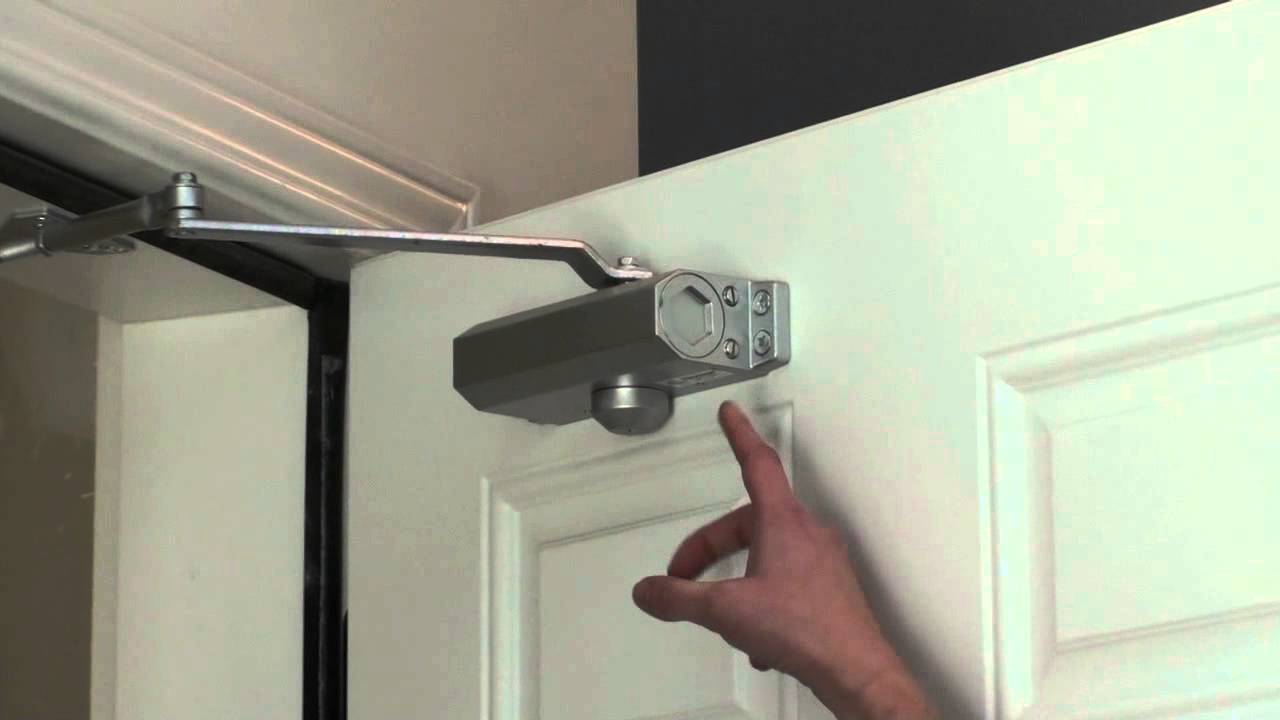
- Regular arm — mounted on the pull side, most power, least attractive, arm projects into the opening.
- Parallel arm — mounted on the push side with the arm folded against the door, the standard for corridors and anywhere the arm would be vulnerable.
- Top jamb — mounted on the frame, used when the door face cannot take the closer.
- Concealed — inside the frame or door. Cleanest appearance, most expensive to service, and requires the frame to be prepped for it.
Openings with heavy traffic and no room for a projecting arm often end up being better served by a power operator rather than a stronger closer — worth evaluating alongside automatic door repair or upgrade options if the same opening keeps generating complaints.
A maintenance routine that prevents most failures
Quarterly, per opening, takes about two minutes:
- Open the door fully and let it go. It should close smoothly, slow slightly at the end, and latch without banging.
- Check for oil at the closer body, the arm pivot and down the door face.
- Check the arm fasteners and the closer mounting screws for movement.
- Check that the door latches from a 5-degree open position — the hardest test and the one that matters on a rated door.
- Note any door being propped and find out why.
Log it. On a portfolio of buildings, a simple per-opening log turns closer replacement into a planned expense instead of an emergency call, and it is the documentation an inspector wants to see.
Frequently asked questions
Can a leaking door closer be refilled?
No. Commercial closers are sealed units. Once the seal fails, the unit is replaced.
My door will not latch in windy weather. Is the closer bad?
Not necessarily. It may be undersized for an exterior opening, or the building may be under pressure. Check the closer’s size rating against the door before replacing anything.
Is it acceptable to prop a fire door open during business hours?
Not with a wedge or a hook. If an opening genuinely needs to stay open, the correct solution is a hold-open device connected to the fire alarm system so the door releases and closes automatically on activation.
How often do commercial closers need replacing?
It depends almost entirely on cycle count. A quiet office door can run for many years; a main entrance in a busy building wears far faster. Traffic volume, not calendar age, is the useful predictor.
Can I adjust the closer myself?
Minor sweep and latch speed adjustments are straightforward with the right screwdriver and small quarter-turn changes. Spring power, backcheck and anything on a rated opening should be left to someone who can verify the door still meets its requirements afterward.
The closer is fine but the door still drags. What now?
The problem is the door or the frame, not the closer. A door that has dropped or a frame that has racked will bind regardless of how the closer is set, and on steel openings that usually means hinge or frame work — see hollow metal and steel door repair rather than adjusting the closer harder.
Bottom line
Closers announce their failures. Oil on the door, a door that slams, a door that hangs, a door that someone has started propping — each one is the hardware telling you something specific. Two minutes per opening per quarter catches all of it, and on rated doors it is the difference between a maintenance item and a written deficiency.