Aluminum vs Hollow Metal Commercial Doors: What Fails First in Ontario
Aluminum Doors or Steel DoorsWhen a commercial entrance needs replacing, the specification usually comes down to two families: aluminum storefront doors, and hollow metal — the insulated steel doors you see on service entrances, stairwells and back-of-house openings. Both are standard, both are appropriate, and picking the wrong one for the opening is one of the more expensive mistakes a property manager can make, because the failure shows up three winters later rather than at handover.
Here is how each actually behaves in Ontario conditions, and what tends to go wrong first.
How the two are built
Aluminum storefront
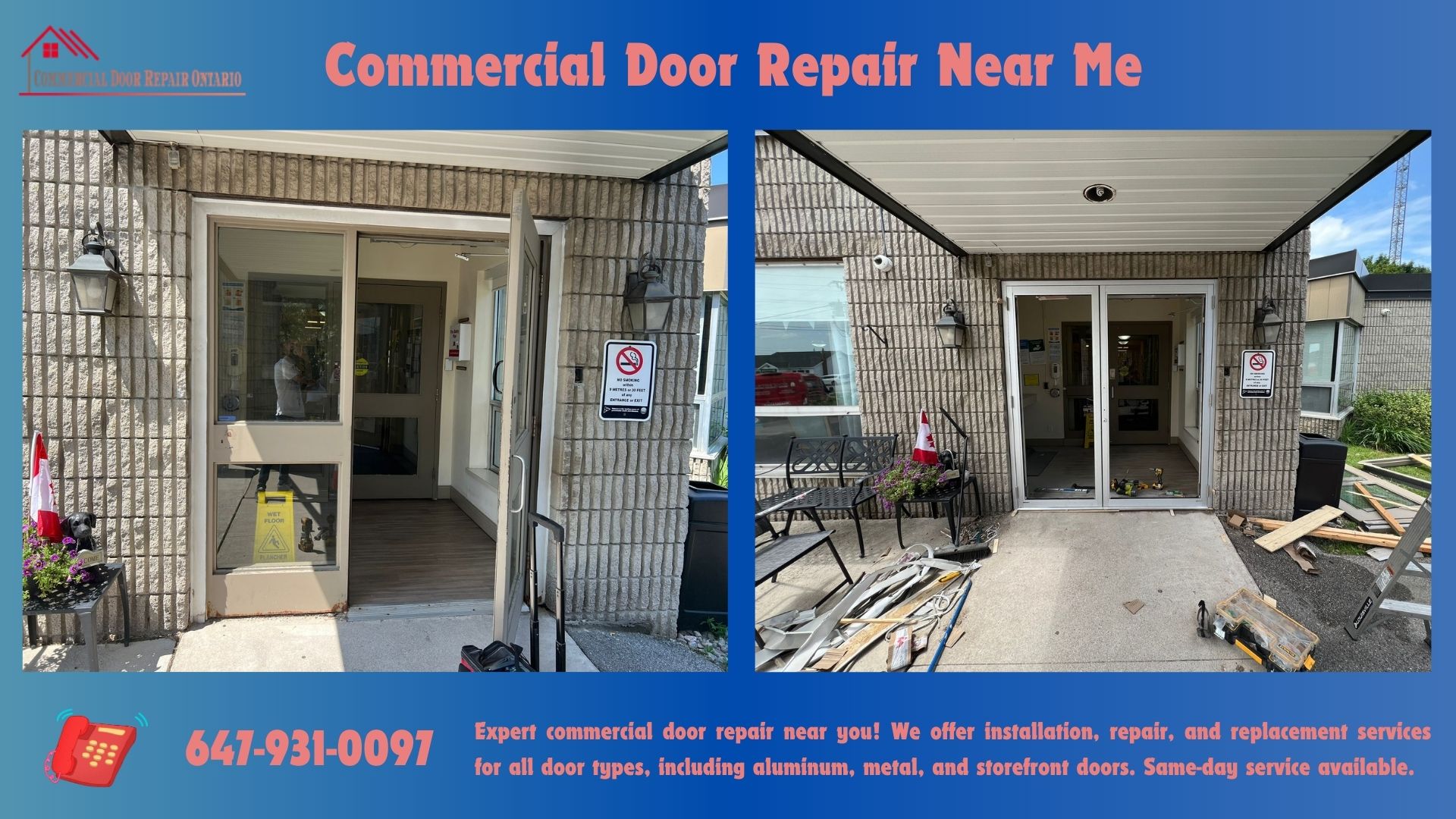
An aluminum door is a frame of extruded tubes — stiles and rails — assembled around a glass infill, with corner joints held by screws or welded blocks. It is light, it does not rust, and it carries a lot of glass, which is why it dominates retail and office entrances where visibility sells.
Its weakness is the joint. All the load from every open and close transfers into those four corners. Aluminum is also a very efficient conductor of heat, so an uninsulated extrusion moves the outdoor temperature straight through to the inside face.
Hollow metal
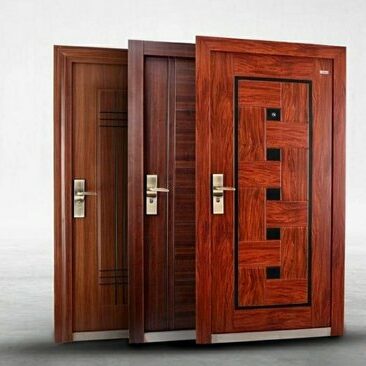
A hollow metal door is two steel skins over an internal core — honeycomb, polystyrene or mineral wool — in a welded or knocked-down steel frame. It is heavy, rigid, holds hardware securely, and it is what you use when the opening needs a fire rating or real security.
Its weakness is corrosion. Steel that has lost its coating in an environment with road salt has a limited life, and the damage starts at the bottom edge where you cannot see it.
What fails first in each
Aluminum: the corners and the pivot
Aluminum doors do not usually break suddenly. They sag. The top corner on the lock side drops a few millimetres, the door starts catching on the threshold, someone forces it, and the joint opens further. On a high-traffic entrance this is a matter of cycles, not years — a busy retail door sees thousands of operations a month.
The bottom pivot takes the entire weight of the door and the glass. When it wears, the door drops and the alignment goes with it. Caught early, this is a pivot and a re-square; left alone, the stile joint deforms permanently and you are into aluminum door repair that involves reworking the frame itself.
Hollow metal: the bottom edge and the frame base
Steel doors fail from the floor up. Salt-laden slush sits against the bottom rail all winter, the coating gives out, and the door skin corrodes from inside the edge outward. By the time rust shows on the face, the internal reinforcement is often gone. The same happens to the frame where it meets the floor, especially in a vestibule that gets mopped.
The second failure point is the hinge side. Hollow metal doors are heavy, and a door that gets kicked open by staff carrying boxes will eventually pull the hinge reinforcement out of the frame.
Choosing by opening, not by preference
The specification should follow what the opening does:
- Customer-facing entrance, high visibility required — aluminum storefront. Nothing else gives you the glass area, and the traffic wear is manageable with scheduled hardware service.
- Fire-rated opening, stairwell, service corridor — hollow metal, no debate. Rated assemblies have to be certified as a unit, door and frame together.
- Rear or side service door, exposed to weather and salt — hollow metal, but specify a galvannealed skin and check the bottom edge treatment. This is where cheap doors reveal themselves.
- Interior high-traffic opening between conditioned spaces — either can work; hollow metal takes abuse better, aluminum is easier on the floor structure.
- Openings with heavy thermal load — if you go aluminum, insist on thermally broken extrusions. A non-broken frame on a north-facing entrance condenses, freezes, and drips onto the floor inside.
The maintenance that actually extends life
Both types last dramatically longer with a small amount of attention:
- Adjust the closer before the door starts slamming, not after. Every slam is an impact load into the corners on aluminum and into the hinge reinforcement on steel.
- Keep the threshold clear and drained. Standing water at the sill is what kills the bottom edge of a steel door and the bottom pivot of an aluminum one.
- Rinse salt off in late winter. Trivial, almost never done, and it measurably extends the life of exterior steel.
- Touch up coating breaches immediately on hollow metal. A scratch to bare steel in November is a rust hole by April.
- Check the pivot and hinge wear twice a year on aluminum. A worn pivot is a cheap part; the sag it causes is not.
When a door has passed the point where adjustment helps — the frame is deformed, the corrosion is through, or the assembly no longer sits square in the opening — commercial door replacement becomes the cheaper path. Continuing to service a failed assembly usually costs more over two years than replacing it did.
Getting the install right
Most premature failures we see trace back to installation rather than the door. A frame that is not plumb puts the entire load onto one hinge. A threshold set without a proper seal lets water under the frame. Hardware mounted without reinforcement pulls out. Whichever material you choose, the installation determines more of the service life than the product spec does.
Frequently asked questions
Is aluminum less secure than steel?
The door material matters less than the glass and the locking hardware. An aluminum storefront with laminated glass and a properly installed deadlatch is a serious deterrent; the same door with annealed glass is not. Specify the glass and the lock, not just the frame.
Can a rusted-through steel door be repaired?
Surface corrosion can be treated and recoated. Perforation through the skin, or a soft bottom rail, generally cannot be repaired to a reliable standard — and if the door is fire-rated, field repairs can void the rating entirely.
Do aluminum doors need to be thermally broken?
On any exterior opening in Ontario, yes, practically speaking. Without it you get condensation on the interior face in cold weather, which drips onto the floor and becomes a slip hazard and a flooring problem.
How often should commercial entrance hardware be serviced?
Twice a year for a normal entrance, quarterly for high-traffic retail. The closer, pivots, locks and weatherstrip are the items that drift, and they are inexpensive to correct before they cause structural wear.
Can I replace just the door and keep the existing frame?
Sometimes, if the frame is square, sound and dimensionally compatible. On a fire-rated opening the answer is usually no — the assembly is certified as a matched set, and mixing components can break the listing.